How we grew repeat hotel bookings 3× with a subscription model
A teardown of Tripsxing — why a subscription layer beat one-off bookings for retention, and how we designed it to grow repeat bookings threefold in year one.
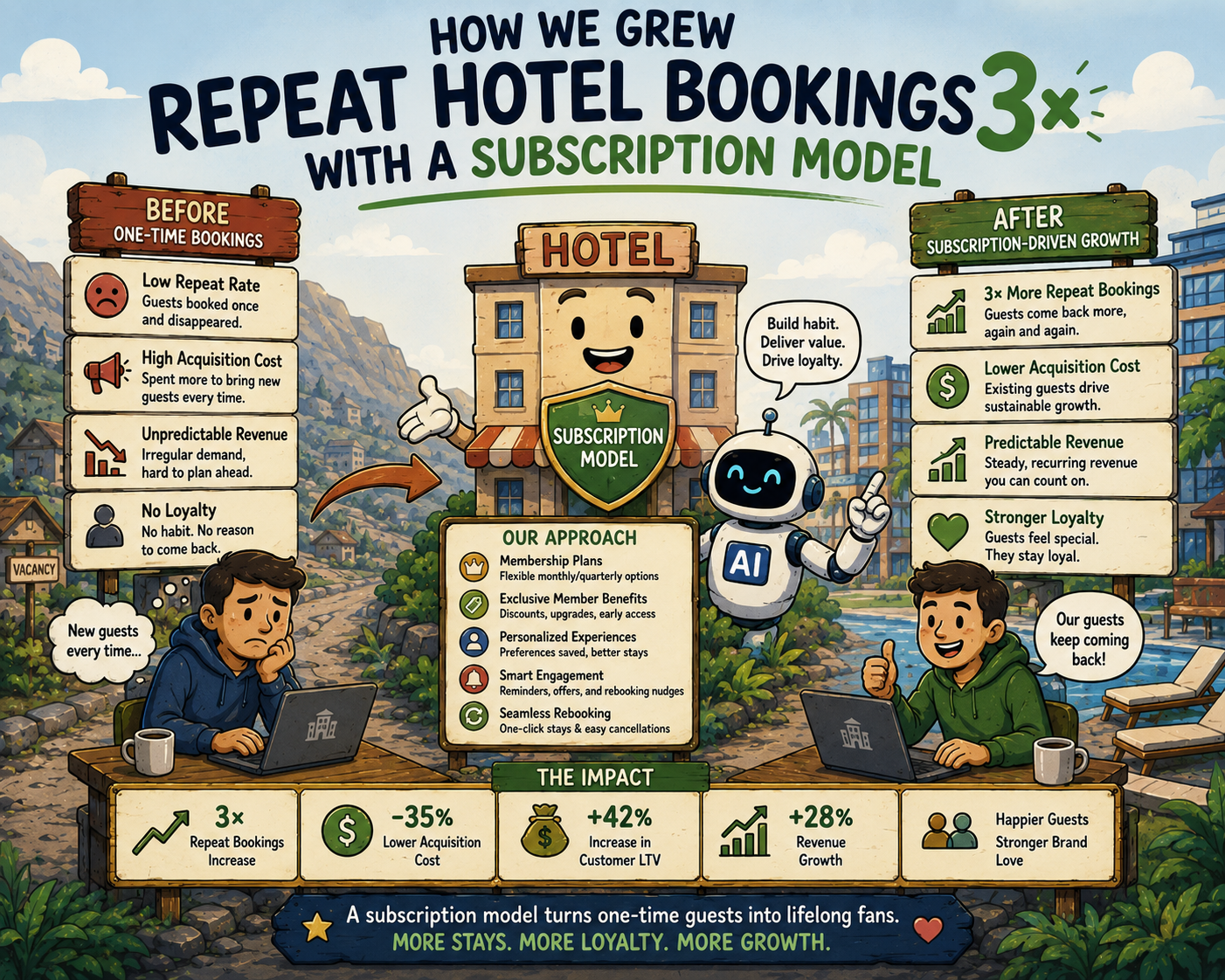
Most hotel booking products live and die by the transaction. A traveler arrives, books once, and disappears into the churn — reacquired months later at full cost through another ad click. We were asked to break that cycle for Tripsxing, a hotel booking platform. The answer wasn’t a better funnel. It was a different business model.
This is how a subscription layer grew repeat bookings threefold in the first year, and what we’d tell any travel team considering the same move.
The problem with one-off bookings
Transactional booking has a structural ceiling: every booking is a fresh acquisition cost. Loyalty points help at the margins, but they reward volume the customer was already going to generate. There’s no recurring relationship — just a series of cold starts.
For Tripsxing, the data was blunt. Acquisition was healthy; repeat rate was not. The product was paying to win the same customers twice.
Why subscription, specifically
A subscription changes the customer’s mental model from “where do I book this trip” to “I already have a place to book trips.” That shift does three things at once:
- It pre-commits the customer. A paid membership creates a reason to return before the next trip is even planned.
- It funds better pricing. Recurring revenue let us offer member rates that single transactions couldn’t justify.
- It makes retention measurable. Renewal is a clean signal of value — far sharper than a vague “satisfaction” score.
The goal was never to sell a subscription. It was to make the next booking the path of least resistance.
How we designed it
We resisted the urge to gate everything behind a paywall. The membership had to feel like an upgrade, not a tollbooth.
Start with the recurring habit, not the discount
Discounts are easy to copy and train customers to wait for sales. Instead we anchored the membership on recurring value: member-only rates, faster rebooking of past stays, and a saved-preferences layer that made each booking quicker than the last. The discount was a feature, not the thesis.
Make the second booking trivial
The single highest-leverage screen was rebooking. Returning members saw their past stays, saved travelers, and preferred room types one tap away. We measured time-to-rebook obsessively and drove it down release over release.
Price for renewal, not signup
We modeled the membership so a member who booked even twice a year came out ahead. That alignment — the customer wins exactly when they use the product — is what made renewals climb instead of cancel.
What moved the numbers
Three changes mapped most directly to the 3× repeat-booking growth:
- Frictionless rebooking turned intent into action before it cooled.
- Member rates gave a concrete, recurring reason to log in rather than comparison-shop.
- Renewal-aligned pricing meant the people getting value were the people we kept.
What we’d tell another travel team
Subscription isn’t a pricing trick bolted onto a booking flow — it’s a commitment to making the next purchase easier than the last. If you can’t point to a screen that gets materially better the second time someone uses it, a subscription will just add a paywall to the same churn.
Start there. The model follows the habit, not the other way around.
Shola Digital designs, builds, and scales software that lasts — including subscription products across travel and beyond. If you’re weighing a recurring-revenue model, start a conversation.