What it actually costs and takes to build an MVP in 2026
An honest breakdown of MVP budgets, timelines, and the trade-offs behind them — so founders can plan with real numbers instead of guesses.
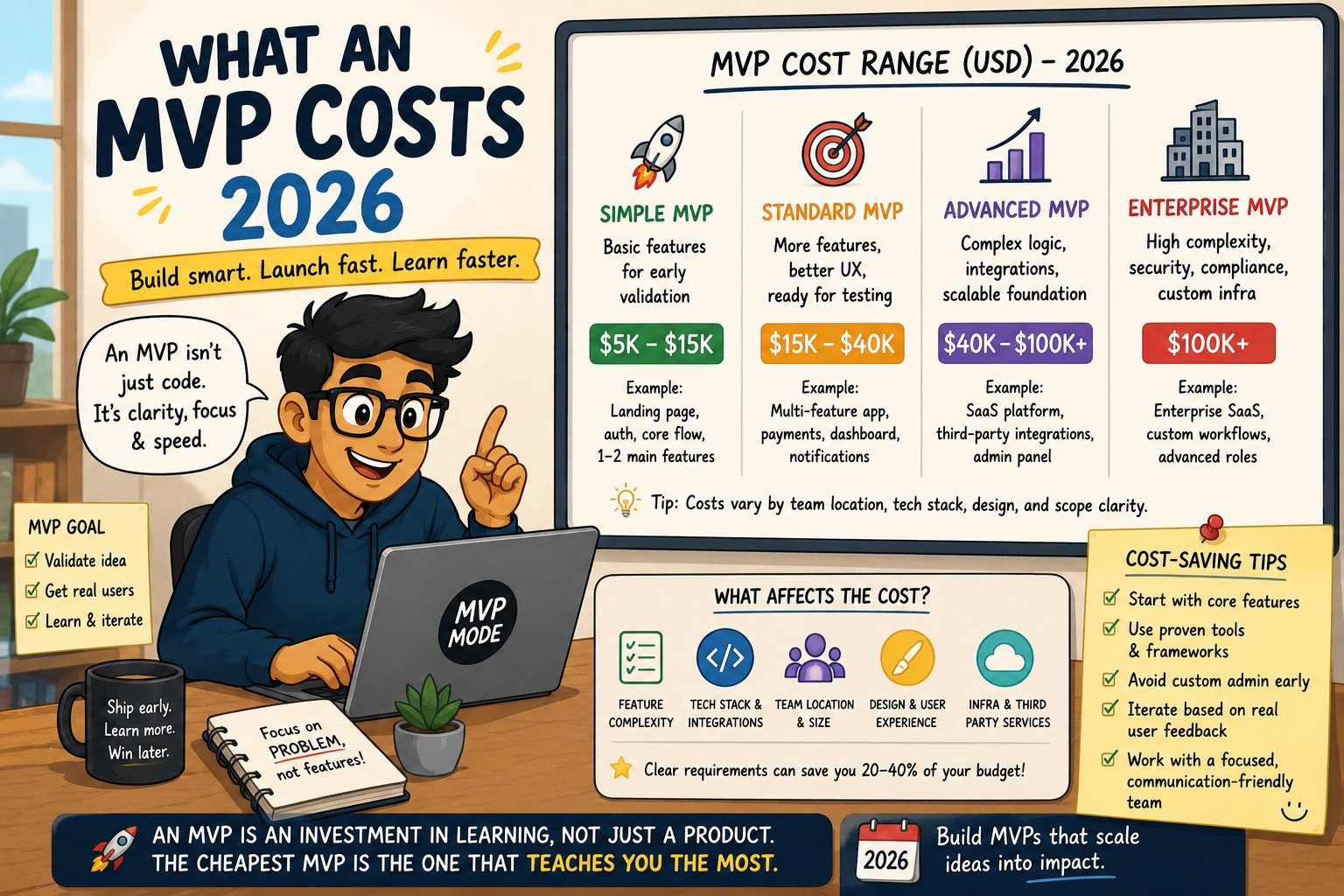
Ask ten agencies what an MVP costs and you’ll get ten ranges and zero clarity. The honest answer is that “MVP” describes a decision about scope, not a fixed deliverable — and the cost follows the decision. Here’s how we scope, budget, and time MVPs in 2026, with the trade-offs spelled out.
What an MVP actually is
A Minimum Viable Product is the smallest thing you can build that lets you learn whether the core bet is true. Not the smallest version of your final vision — the smallest test of the riskiest assumption. If your build doesn’t reduce a real risk, it isn’t an MVP; it’s a v1 in disguise.
The right MVP question isn’t “what features do we cut?” It’s “what’s the one thing we most need to find out?”
A realistic timeline
For a focused MVP with a single core flow, a typical shape is:
- Discovery & scope (1–2 weeks): define the riskiest assumption, the one flow that tests it, and the metric that signals success.
- Design (2–3 weeks): the core screens, prototyped and validated — not a full design system.
- Build (6–10 weeks): the one flow, end to end, on infrastructure you won’t have to throw away.
- Launch & learn (ongoing): ship to real users, instrument, iterate.
Most genuine MVPs land in the three-to-four-month window from kickoff to real users. Anything promising “in two weeks” is usually a prototype; anything stretching past six months has usually stopped being minimal.
What drives the cost
Budget is mostly a function of four variables, not a price list:
- Scope — how many flows, and how novel. One well-built flow is cheap; “just a few screens” that each hide a subsystem is not.
- Integrations — payments, third-party data, and compliance each add real surface area.
- Polish bar — a consumer app users will judge on feel costs more than an internal tool.
- Team seniority — senior engineers cost more per week and almost always less per outcome, because they avoid the rework that sinks cheap builds.
Where founders waste money
- Building the vision instead of the test. Every feature added “while we’re at it” delays the learning that justifies the spend.
- Premature scale. Architecting for a million users you don’t have yet is paying interest on a loan you may never take.
- Skipping discovery. A week of scoping routinely saves a month of building the wrong thing.
How to plan it well
Decide the one question first. Fund the build that answers it. Hold the rest — confidently — for after you’ve learned something. A good MVP partner will push back on scope, not pad it, because the cheapest MVP is the one that teaches you the most per dollar.
Shola Digital scopes and builds MVPs for ambitious teams — senior engineering and product thinking from first idea to first users. Tell us what you’re testing.