What good engineering handover looks like when a vendor leaves
The real test of a development partner is what remains after they're gone. A practical guide to taking ownership of software someone else built — the six steps, the documents that matter, and the red flags that mean you don't own it yet.
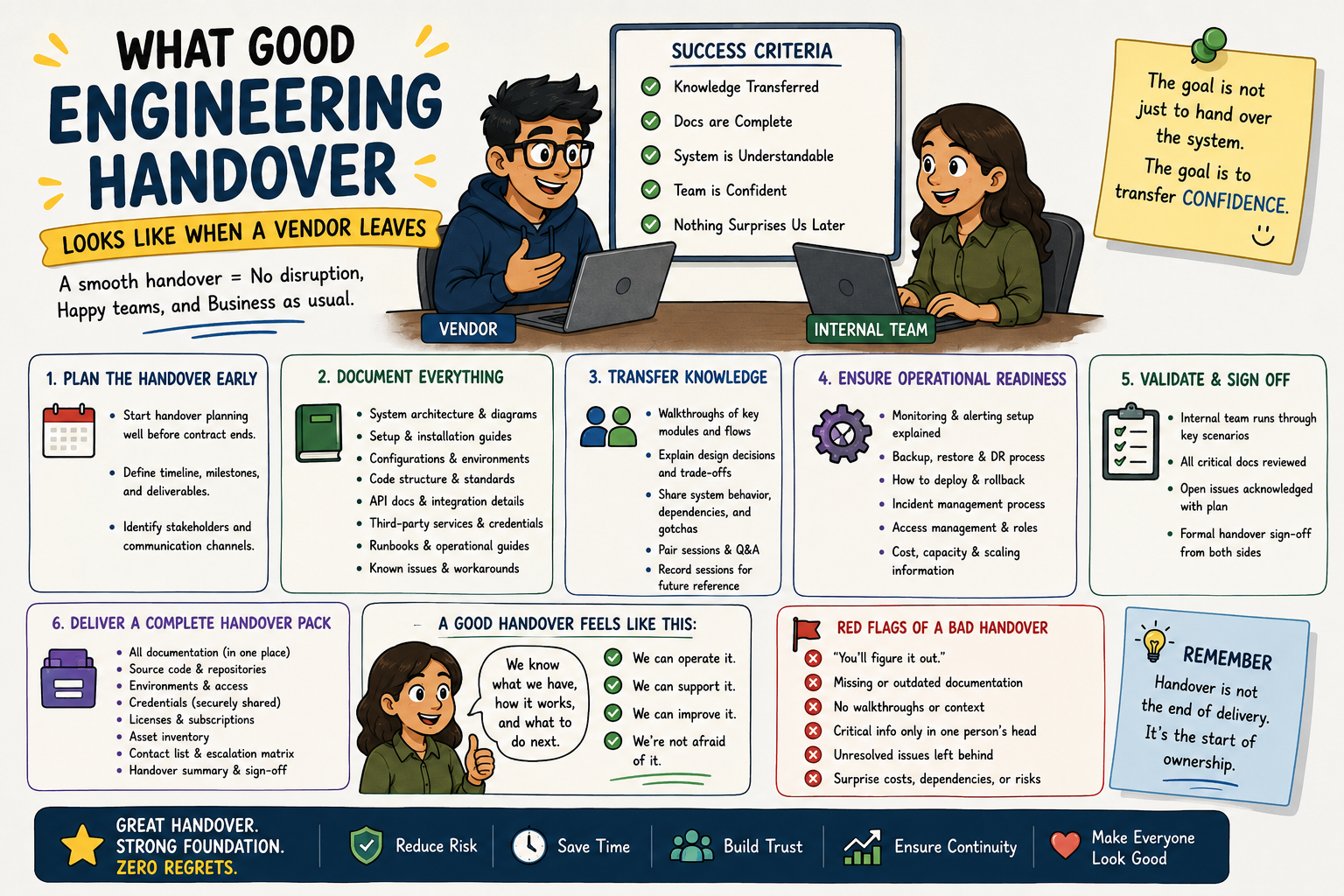
Every outsourced software project ends the same way: the vendor leaves, and what remains is whatever they left behind. Sometimes that’s a system your team can confidently own. More often it’s a repository, a shrug, and a support retainer priced like a hostage negotiation.
As a consultancy, we’re on the delivering end of handovers — so consider this both a checklist for buyers and a standard we think vendors should be held to.
The goal is not just to hand over the system. The goal is to transfer confidence.
A handover is done when your team can change the system without calling anyone. Not run it. Change it. Operate it, support it, improve it — without being afraid of it.
What “done” actually means
Before you get into artifacts and walkthroughs, agree on the outcome. A good handover leaves your team able to say five things with a straight face:
- Knowledge was transferred — not presented once, but practiced under supervision.
- Docs are complete — current, findable, and written for someone who wasn’t on the project.
- The system is understandable — architecture, debts, and trade-offs are visible, not tribal.
- The team is confident — they would ship a fix on a Friday afternoon without panic.
- Nothing surprises you later — accounts, costs, dependencies, and known issues are on the table now.
If any of those fail, the contract ending is a date on a calendar, not a transfer of ownership.
The handover test
Three questions, answerable by your own people (or your next partner) without the outgoing vendor in the room:
- Can you build and deploy it from scratch? From a fresh laptop to running in production, following only the written docs. If the deploy lives in one vendor engineer’s shell history, you don’t own the system — they do.
- Can you fix a bug end to end? Reproduce it locally, find the code, change it, run the tests, ship it. This exercises everything: environment setup, code readability, test coverage, release process.
- Do you hold all the keys? Every account, every credential, every third-party service — owned by your organization’s accounts, not the vendor’s. Domain registrar, cloud console, app store listings, DNS, monitoring, the email service. Orphaned accounts surface at the worst moments, usually as an expired card on an account nobody can access.
Pass those three and the rest of this guide is polish. Fail any of them and you’re renting continuity, not owning it.
Six steps that actually transfer ownership
Treat handover as a project with a timeline, owners, and exit criteria — not a farewell meeting in the final week.
1. Plan the handover early
Start well before the contract ends. Six weeks is a working minimum for a non-trivial system; more if there are regulated environments, multiple products, or a brand-new internal team.
Define timeline, milestones, and deliverables. Name the people on both sides. Decide where questions go (one channel, not six private chats). Schedule the pair sessions and the “you drive, we watch” windows now — calendar scarcity is how handovers get compressed into a single Zoom that nobody remembers.
Negotiate the shape of this handover at the start of the engagement, not the week invoices stop. Handover quality clauses, IP and account ownership, documentation standards — they cost almost nothing in a signed contract and everything to extract during a wind-down.
2. Document everything that walking engineers into a wall would otherwise require
Volume isn’t the point. Specificity is. The documents that save people six months later are the ones teams usually skip:
- System architecture and diagrams that match production, not the pitch deck version
- Setup and installation that a new laptop can follow cold
- Configurations and environments — what differs between staging and prod, and why
- Code structure and standards — where things live, what “good” means here
- API docs and integration details — especially the awkward third-party edges
- Third-party services and credentials (inventory first; share credentials securely, second)
- Runbooks and operational guides — deploy, rollback, logs, known failure modes
- Known issues and workarounds — the embarrassing ones included
Ask for the real runbook, not the polished one. The entries people are slightly ashamed of are usually the ones that matter at 2 a.m.
3. Transfer knowledge by doing, not presenting
Knowledge doesn’t move by slide deck. It moves when the receiving team does the work with the outgoing team available but gradually hands-off.
Walk through key modules and flows. Explain the design decisions and trade-offs — why the queue exists, not just that it does. Share the gotchas: the job that must run before midnight, the partner API that lies about its rate limits, the table nobody should query directly.
Pair on a real bug. Pair on a real deploy. Record the sessions so the fourth engineer who joins next quarter isn’t starting from zero. Every question that comes up that week becomes a documentation fix while someone who knows the answer is still under contract.
By the final week, the vendor should be observing, not driving.
4. Ensure operational readiness
Shipping code is half the system. The other half is keeping it alive.
Before sign-off, the receiving team should be able to explain — and preferably perform — monitoring and alerting, backup and restore (including a tested restore, not a theorized one), disaster recovery expectations, deploy and rollback, incident process, access and roles, and the boring economics of the platform: cost drivers, capacity, and how you’d scale if traffic doubled.
If “who’s on call and what do they page?” has no answer owned by your organization, you are not ready for the vendor to leave.
5. Validate and sign off
This is where many handovers quietly fail: everyone assumes understanding because everyone attended the same meetings.
Have the internal team run the key scenarios themselves. Review critical docs against reality. Acknowledge open issues with a written plan — ownership, severity, next action — not a shared hope that they’ll evaporate. Then do a formal sign-off from both sides. Formal sounds bureaucratic until the week something breaks and nobody can say what was agreed.
6. Deliver a complete handover pack
Put the artifacts in one place the receiving team already uses. A good pack includes:
- All documentation, linked and current
- Source code and repositories — with history, not a zip of HEAD
- Environments and access
- Credentials, shared through a proper secrets process
- Licenses and subscriptions
- Asset inventory (infra, domains, certificates, devices, apps)
- Contact list and escalation matrix — including third parties
- A short handover summary and the signed exit criteria
The pack is evidence. The confidence is what the test in the section above measures.
Red flags of a bad handover
Walk away — or slow the exit — if you hear or see any of these:
- “You’ll figure it out.” That’s not a handover; that’s abandonment with a smile.
- Missing or outdated documentation that nobody plans to fix before the end date.
- No walkthroughs, no pair sessions, no recorded context — only a shared drive dump.
- Critical knowledge in one person’s head on either side of the table.
- Unresolved issues left behind with no severity, owner, or mitigation.
- Surprise costs, dependencies, or risks that surface after credentials are cut off.
A vendor who resists being measured on these is telling you how the engagement ends before it has.
Run it as a project, not a meeting
The classic failure is the final-week formality: a two-hour walkthrough, a wiki export, goodbye. Compressing six weeks of ownership into one ceremony is how teams inherit systems they cannot change.
Start early. Have your people (or the incoming partner) deploy a release with the vendor watching, then fix a real bug with the vendor available but hands-off. Use the remaining runway to close every gap the exercises expose. End with the vendor observing and your team driving.
The vendors worth hiring won’t resist any of this. Making ourselves unnecessary is the deliverable. A client who can leave easily is, oddly enough, the kind that tends to stay.
Handover is not the end of delivery. It’s the start of ownership.