Where AI actually earns its place in a product (and where it doesn't)
A practical framework for deciding when to add AI to a product — the use cases that pay off, the ones that don't, and how to tell them apart before you build.
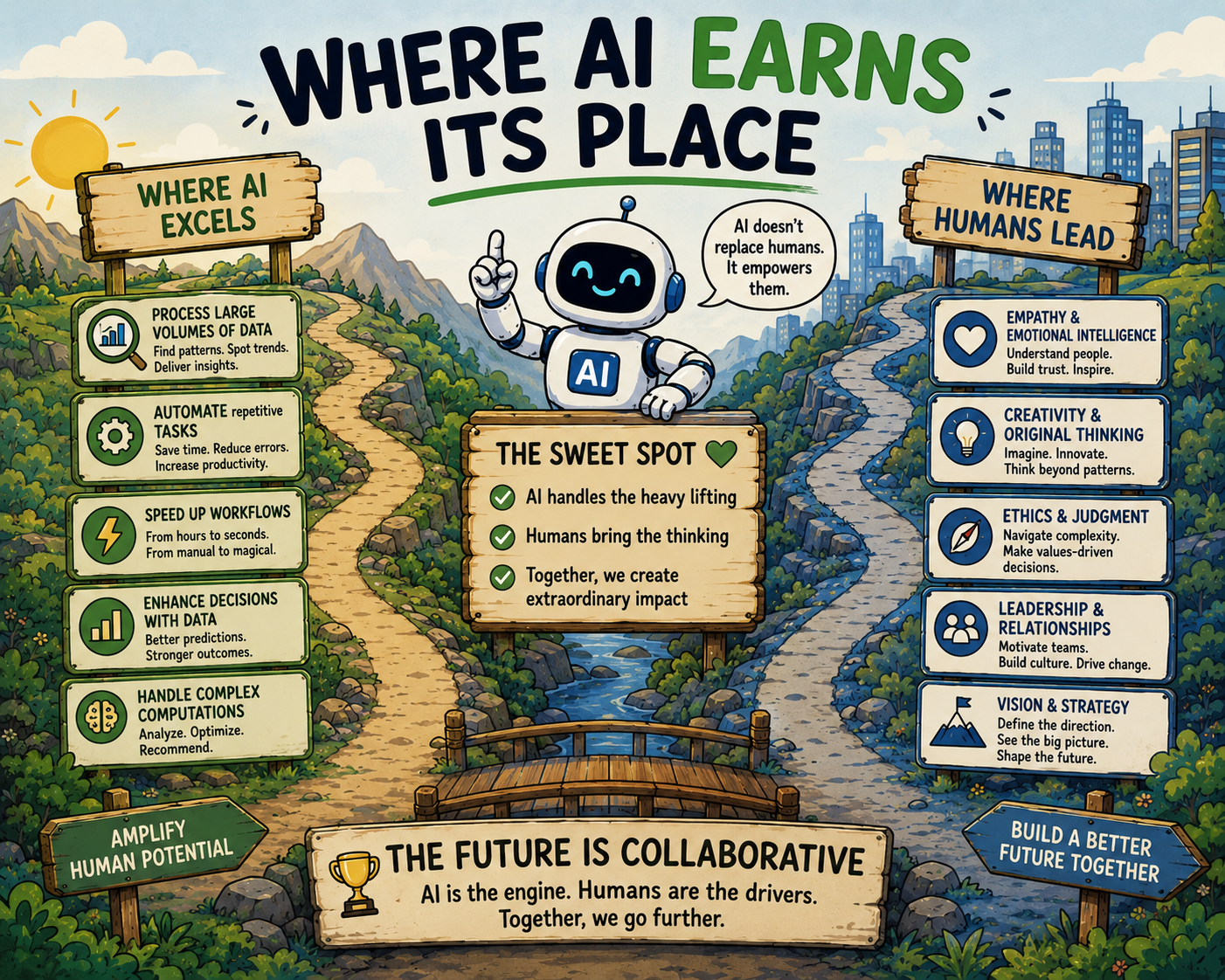
“Add AI” has become a roadmap item the way “add social” was a decade ago — a mandate in search of a problem. Some of it is transformative. Much of it is a more expensive way to do something a form already did well. Here’s how we decide where AI earns its place in a product.
The test: does it remove a real cost?
AI earns its place when it removes a cost the user is genuinely paying — usually one of three:
- The cost of blank-page effort: drafting, summarizing, generating a starting point.
- The cost of judgment at scale: triaging, ranking, or classifying more items than a human can review.
- The cost of unstructured input: turning messy text, speech, or images into something the product can act on.
If a feature doesn’t clearly reduce one of those, AI is probably the wrong tool — and a deterministic feature will be faster, cheaper, and more predictable.
The question isn’t “could AI do this?” Almost anything could. It’s “does AI do this meaningfully better than the boring alternative?”
Where it pays off
Synthesis over search. When users drown in their own data — notes, tickets, documents — AI that summarizes and answers questions creates value a search box can’t.
Assisted, not autonomous. The strongest AI features keep a human in the loop: draft-and-edit, suggest-and-approve. Users get the speed without ceding control, and you sidestep the trust cliff of full automation.
High-volume judgment. Routing, tagging, and first-pass review at a scale where hiring more people doesn’t make sense.
Where it doesn’t
- Tasks that demand a guaranteed answer. If “usually right” isn’t good enough — billing, compliance, anything legally binding — don’t put a probabilistic model in the critical path.
- Problems a rule already solves. If a simple condition or a well-designed form handles it, AI just adds cost, latency, and a new failure mode.
- Features added for the demo. If the only beneficiary is your launch announcement, users will feel it.
How to decide before you build
- Name the cost the feature removes. If you can’t, stop.
- Check the failure tolerance. Can the user shrug off a wrong answer, or does one mistake break trust?
- Compare to the boring version. If a deterministic feature gets 80% of the value at 20% of the complexity, build that first.
- Design for the human. Assume the model will be wrong sometimes, and make being wrong cheap to catch and correct.
AI fluency isn’t about putting a model in everything. It’s knowing exactly where a model changes the economics of a problem — and having the discipline to leave it out everywhere else.
Shola Digital builds AI into products where it genuinely earns its place — and tells you when it doesn’t. Talk through your use case.